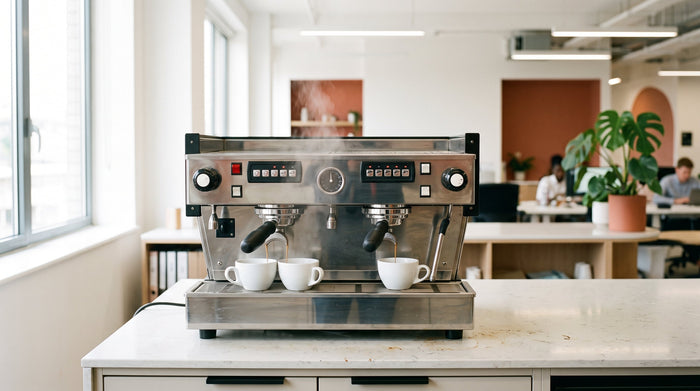
Ask most offices what their coffee needs, and the answer comes back the same way almost every time: a better machine. Facilities teams compare bean-to-cup models, weigh up leasing versus buying, argue about footprint in the kitchen — and then treat the decision as finished the moment the machine arrives. It isn't. The machine is maybe a third of what actually determines whether your office coffee is good or forgettable.
It starts with the beans
Put stale, over-roasted commodity beans through a top-of-the-range machine and you'll get a technically competent, forgettable cup. Put well-sourced, properly roasted beans through a mid-range machine, maintained on schedule, and you'll get something people actually look forward to. We say this as a business that sells machines: the equipment sets a ceiling, but the beans decide whether you get anywhere near it. Offices that treat coffee quality as "solved" once the machine is installed are usually the ones where staff quietly start bringing in their own flask again within three months.
Sizing is where most decisions actually go wrong
A 40-person studio and a 400-person office tower need entirely different setups, and not just in obvious ways. It's not headcount that matters most — it's concentrated demand. A business with 150 people spread across flexible hours needs something very different from a business with 150 people who all arrive between 8:45 and 9:15 and queue at the same machine. Undersizing shows up fast: slow output, people giving up and leaving, a machine straining through back-to-back cycles it wasn't built for. We ask about peak-time footfall before we ask about total headcount, because that's the number that actually drives the spec.
Then there's who's behind it
This is the part that's easy to treat as a nice-to-have rather than a real differentiator, and we'd argue it shouldn't be. Roughly 7 in 10 hands in coffee — the people picking, sorting, grading, drying — belong to women, and the vast majority of them are never credited, never named, and rarely paid what the work is worth. A workplace coffee decision made purely on price per kilo ignores that entirely. One made with the sourcing chain in mind means your office's daily coffee run is doing something beyond caffeinating the 10am stand-up — it's putting weight behind who actually gets paid fairly for growing it.
What a complete workplace coffee setup actually includes
In practice, "coffee partner" rather than "coffee supplier" means five things working together, not one: a machine specified to your real footfall and space, professional installation that doesn't leave facilities staff improvising, a maintenance schedule that's actually followed rather than reactive, filters and servicing that happen before something breaks rather than after, and coffee that people would choose even if it weren't free. Miss any one of those five and the whole thing degrades slowly — which is exactly why so many offices end up with a machine nobody trusts within eighteen months.
The maintenance gap nobody budgets for
Here's the uncomfortable truth about commercial coffee machines: the failure mode is rarely dramatic. It's not that the machine breaks down one Tuesday morning. It's that descaling gets pushed back a month, then two, then the water tastes faintly off, then someone in the office starts a WhatsApp thread about it, and six months later "the coffee's gone downhill" becomes accepted wisdom nobody questions. Financing the machine is the easy part of the budget conversation. Financing the ongoing service — filters, descaling, callouts, replacement parts — is the part that actually protects the investment, and it's exactly why we build it into every Corporate Coffee Solutions plan rather than treating it as an optional extra.
Curious what a properly specified workplace coffee setup would look like for your office? Request a workplace quote and we'll walk the numbers with you — footfall, space, budget, and what's actually realistic for your team.