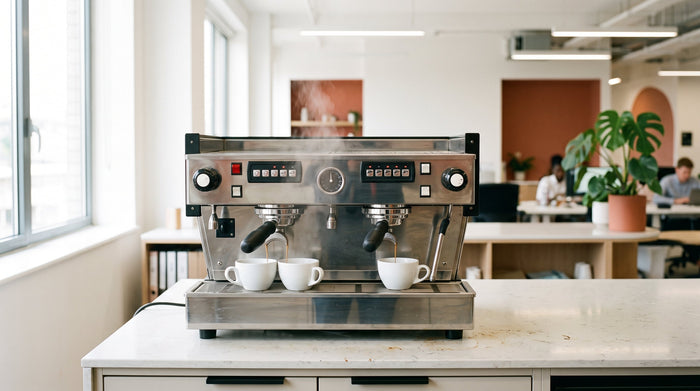
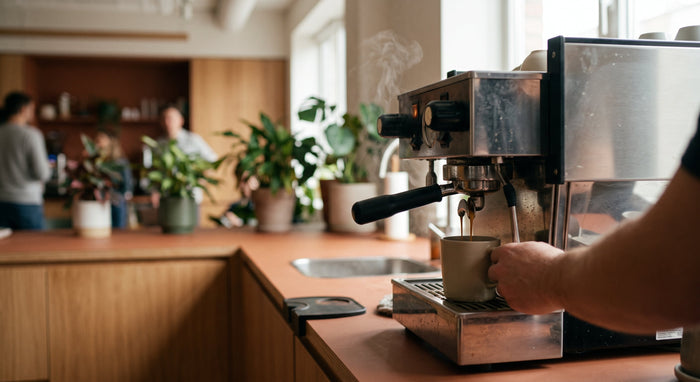
Choosing an office coffee machine often plays out like choosing a car by the badge on the bonnet — the model name gets more attention than the questions that actually determine whether it'll work for your space. Twenty-five-plus years of doing this has taught us it's the boring, practical questions that separate a good decision from an expensive mistake.
What's your real peak, not your headcount?
Total staff numbers tell you almost nothing on their own. What matters is how many people want coffee in the same fifteen-minute window. A team of 60 spread across flexible start times behaves nothing like a team of 60 who all arrive at 9am sharp. Undersizing for peak demand is the most common and most expensive mistake we see — a machine that's technically "rated" for your headcount but chokes every single morning.
Bean-to-cup, filter, or capsule — and why "better" is the wrong question
Bean-to-cup machines grind fresh for every single drink and, done properly, produce the best cup available in an office setting — but they demand real, regular upkeep and a bigger footprint. Filter systems suit high-volume, lower-fuss environments where consistency across large batches matters more than customisation. Capsule systems fit smaller teams, satellite offices, or spaces where nobody wants the responsibility of maintaining a full machine. None of these is objectively superior. The mistake is choosing based on what looks impressive in a supplier's showroom rather than what actually matches your team's real habits.
Who is actually responsible for it, on a Tuesday, in six months?
Every machine needs a person, or a proper process, responsible for the unglamorous basics — topping up milk, checking water levels, clearing spent grounds. This question gets skipped at the buying stage constantly, and it's the reason perfectly good machines end up neglected within a year. If there's no clear owner, that needs solving before the machine is chosen, not after it arrives.
What does "servicing" actually cover, specifically?
"Servicing included" can mean radically different things depending on the supplier. Ask exactly what's covered: filters, descaling schedule, response time when something breaks, whether call-outs are chargeable, whether parts are included or billed separately. This is the single most under-interrogated line item in any workplace coffee contract, and the one that determines whether year two feels like a relief or a fight. At Woma, installation, ongoing servicing and filters sit inside the Corporate Coffee Solutions package as standard, with financing available so the upfront capital cost isn't the whole decision.
Does it actually fit the space and the noise tolerance?
A machine that looks superb in a product catalogue but doesn't fit the counter, blocks a walkway, or grinds loudly enough to interrupt calls in an open-plan office causes daily friction that has nothing to do with coffee quality. Measure the actual space, check the decibel rating if noise is a concern, and think about where the queue will physically form before signing off on a model.
The financing question worth asking upfront
Buying outright ties up capital on a depreciating asset; leasing spreads the cost but adds a long-term commitment. Neither is automatically right — it depends on your cash flow position and how confident you are in your headcount over the next few years. Ask for both options costed out before deciding, rather than defaulting to whichever the supplier pushes first.
Not sure which setup actually fits your office? Request a workplace quote and we'll walk you through the real questions — footfall, format, servicing and financing — before you commit to anything.